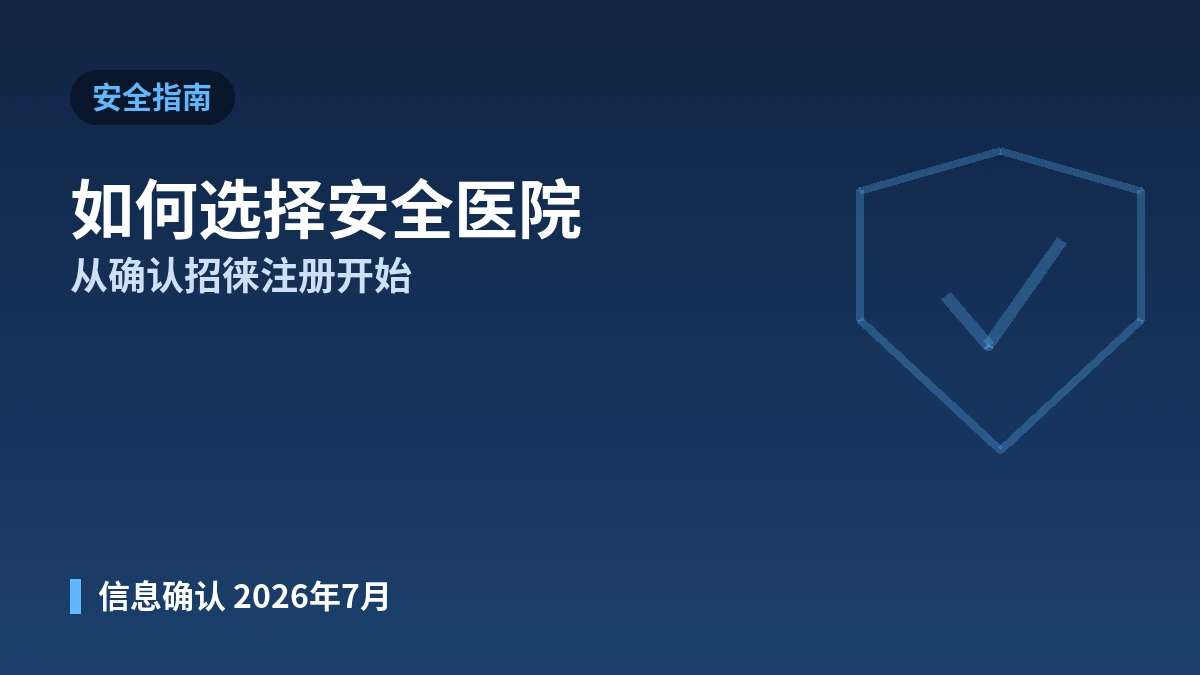
(A clinic-selection safety guide for international visitors coming to Korea for aesthetic medical purposes)
[Document type] Information guide for international patients / Verifying attracting-institution registration, liability insurance, staff qualifications, and medical dispute response
* This content is reference material prepared based on public information verified as of July 2026, and is not intended to guarantee the safety or treatment effect of any specific clinic or to defame any institution. Laws·systems and registration information may change, so please be sure to reconfirm the latest details before your visit through Prettykeep and official bodies (Medical Korea, the Korea Medical Dispute Mediation and Arbitration Agency, etc.).
────────────────────────────────────
Introduction
────────────────────────────────────
For international visitors planning aesthetic medicine (skin procedures·plastic surgery) in Korea, a question as important as "which clinic is good" is "can this clinic legally and safely treat foreign patients?"
If you decide based only on price, reviews, or fame, you may miss what really matters—whether the institution can legally attract foreign patients, whether it has insurance in case of a medical accident, and what the qualifications of the staff performing the procedure are. Knowing in advance how you can respond if a problem occurs also lets you visit with peace of mind.
This guide is not written to recommend or defame any specific clinic. It organizes the criteria and methods by which a visitor can verify safety within Korea's system, and the official procedures available if a problem arises.
────────────────────────────────────
Why "safety verification" comes first
────────────────────────────────────
Aesthetic medicine is undeniably a medical act. Even a procedure that looks simple can carry risks such as anesthesia, injection, infection, and vascular-related complications. International patients have a fixed stay and a language barrier, so responding when a problem occurs can be harder than for domestic patients.
So it is safer to first verify the following, rather than "is it cheap·is it famous."
- Whether this institution can legally attract·treat foreign patients
- Whether there is a compensation system prepared for a medical accident
- Whether the treating staff's qualifications can be verified
- Whether an explanation·consent·emergency-response system is in place
- What official procedures you can use if a problem arises
────────────────────────────────────
1. Verifying registration as a foreign-patient attracting medical institution
────────────────────────────────────
In Korea, under the "Act on Support for Overseas Expansion of Healthcare and Attraction of Foreign Patients," medical institutions and attracting agencies that wish to attract (recruit·broker) foreign patients must register with the government.
Key points
- Only registered medical institutions·attracting agencies can legally attract foreign patients.
- Attracting foreign patients without registering is prohibited by law, and under the published rules, unregistered attractors are indicated as subject to punishment (up to 3 years' imprisonment or a fine of up to KRW 30 million).
- In other words, whether an institution is a "registered attracting medical institution" is a basic indicator of safety·legality.
How to verify
- You can check registered attracting medical institution information on "Medical Korea," the foreign-patient attraction information portal operated by the Ministry of Health and Welfare·the Korea Health Industry Development Institute (KHIDI).
- After checking public information such as registration status, institution name, and treatment departments, it is safer to reconfirm through Prettykeep before your actual visit.
Caution
- A visit through an unqualified broker or unregistered brokering can be risky. Book through a properly registered institution·channel.
────────────────────────────────────
2. Whether medical-accident liability insurance is in place
────────────────────────────────────
Foreign-patient attracting medical institutions are required to subscribe to medical-accident liability insurance or a medical indemnity mutual-aid association in preparation for a medical accident.
Published insurance subscription standards (guidance criteria)
- Hospital·clinic-level medical institutions: an annual compensation limit of at least KRW 100 million
- General hospitals: an annual compensation limit of at least KRW 200 million
Meaning
- This means that a minimum compensation system for patient protection is in place in the event of a medical accident.
- Insurance·mutual-aid subscription does not "guarantee safety" but serves as "the basis of the compensation procedure if a problem occurs."
What to check
- If registered as an attracting medical institution, related insurance·mutual-aid subscription is presumed. If needed, you can request through Prettykeep to confirm the public information related to the institution's registration·insurance.
────────────────────────────────────
3. Verifying staff qualifications — license·specialist·treatment department
────────────────────────────────────
The most commonly misunderstood point in aesthetic medicine is the term "specialist." It is important to understand three things separately.
[1) Physician license]
To practice legally, one must have a physician license. This is a basic requirement.
[2) Specialist qualification]
A "specialist" is a physician who has completed training in a specific department (e.g., dermatology, plastic surgery) and obtained the qualification. Even the same aesthetic procedure may be labeled differently depending on whether the treating staff is a specialist in that department or a general physician.
[3) Treatment-department display]
The "treatment department" displayed on a clinic's sign or promotion may differ from the actual staff's specialist qualification. For example, a display of "○○ treatment" does not necessarily mean a specialist in that department.
What to check
- Check who will perform the procedure, whether they hold a specialist qualification, and in which department.
- It is also good to check whether the consulting staff and the actual treating staff are the same.
- Do not exaggerate parts that cannot be confirmed with public qualification information; request confirmation through Prettykeep before your visit.
Caution
- Whether expressions such as "specialist"·"authority" in ads·reviews match the actual qualification must be verified separately.
────────────────────────────────────
4. Explanation·consent·emergency-response system
────────────────────────────────────
A safe institution has a sufficient explanation and consent procedure before the procedure, and an emergency-response system.
What to check
- Whether you received an explanation of the procedure's purpose·method·risks·alternatives·recovery process
- Whether you understand the consent form before signing (have hard-to-understand parts explained through interpretation)
- Whether there is guidance on the anesthesia method and emergency response (emergency equipment·transfer system, etc.)
- Whether the contact·response method is provided if abnormal symptoms occur after the procedure
- Whether you can receive documents such as the medical record·receipt
Distinguishing consent forms
- Consent to care·procedure, consent to anesthesia, and consent to use of photos·personal information have different purposes. Check each separately, and ask whether you can decline items you do not want.
────────────────────────────────────
5. The traps of ads·reviews·price
────────────────────────────────────
In choosing a clinic, ads and reviews are only reference material, not grounds for safety.
Warning signs
- Exaggerated·absolute expressions such as "no side effects," "100% satisfaction," "the best·the only"
- Abnormally low prices or decision pressure like "today only"
- Excessive brokering by unqualified brokers, attraction through an unregistered channel
- Promotion that declares an effect based only on before-and-after photos (individual variation·staging possible)
- Reviews·ratings that are excessively and uniformly positive
A safe approach
- Price is only one of the judgment factors; view it comprehensively together with registration·qualifications·explanation·aftercare.
- Use a properly registered institution and an official booking channel (e.g., Prettykeep).
────────────────────────────────────
6. How to respond if a problem occurs
────────────────────────────────────
In preparation for an abnormality or dispute after a procedure, it is good to know the response procedures in advance.
[Emergency situation]
- If emergency symptoms such as severe pain, rapid swelling, skin color change, difficulty breathing, or vision abnormality occur, visit the nearest emergency medical facility immediately. This takes priority over everything.
[Securing records]
- Secure related documents·materials such as the medical record, consent form, receipt, procedure details, and photos. These are important in subsequent consultation·mediation·dispute procedures.
[Official medical-dispute mediation body]
- Korea has the Korea Medical Dispute Mediation and Arbitration Agency (K-MEDI), established under the "Act on Remedies for Injuries from Medical Malpractice and Mediation of Medical Disputes."
- According to public information, this system can apply to foreigners as well as nationals, and mediation can be requested online·by mail·by fax.
- For foreigners·overseas Koreans, it is guided that, exceptionally, a person other than a legal representative·spouse·lineal ascendant/descendant·sibling can also apply on their behalf after receiving power of attorney in writing.
- Confirm the latest procedures and required documents (mediation application form, ID copy, medical-record copy, etc.) on the official website of the Korea Medical Dispute Mediation and Arbitration Agency.
[Prettykeep's role]
- Prettykeep supports booking·communication and can help organize and convey related inquiries if a problem occurs. However, it does not guarantee a medical judgment or the legal representation·outcome of a dispute.
────────────────────────────────────
TOP 10 to verify before visiting, for a safe clinic
────────────────────────────────────
No. 1
Verify attracting-institution registration
Check on Medical Korea whether it is a registered attracting medical institution.
No. 2
Liability insurance system
Attracting institutions presume liability insurance·mutual-aid (clinic 100M·general hospital 200M or more).
No. 3
Verify staff license·specialist
Check the treating staff's qualification and department.
No. 4
Distinguish treatment-department display
A sign's·promotion's "treatment department" may differ from the actual specialist qualification.
No. 5
Explanation·consent procedure
Explanation of purpose·risks·alternatives and understanding the consent form.
No. 6
Anesthesia·emergency-response system
Check guidance on the anesthesia method and emergency response.
No. 7
Beware of exaggerated ads·absolute claims
Be wary of "no side effects·100%" expressions and decision pressure.
No. 8
Beware of unqualified brokers
Use a properly registered channel instead of unregistered brokering·abnormal routes.
No. 9
Secure records·documents
Keep medical records·consent forms·receipts·photos.
No. 10
Know the dispute-response route
Emergency first, then official procedures such as K-MEDI.
────────────────────────────────────
Detailed explanation
────────────────────────────────────
[No. 1 · Verify attracting-institution registration]
To attract foreign patients, registration is required by law. Whether it is registered is the first indicator of legality and safety. Check the public registration information on the Medical Korea portal, and reconfirm through Prettykeep before your visit.
[No. 2 · Liability insurance system]
Attracting medical institutions presume subscription to medical-accident liability insurance·mutual-aid (published criteria: hospital·clinic level at least KRW 100 million per year, general hospitals at least KRW 200 million). This is the basis of the compensation procedure in the event of an accident and does not guarantee safety itself.
[No. 3 · Verify staff license·specialist]
Check whether the staff who will perform the procedure hold a license, whether they hold a specialist qualification, and in which department. Since the consulting staff and the treating staff may differ, it is good to check both.
[No. 4 · Distinguish treatment-department display]
A clinic's "treatment department" display does not necessarily mean a specialist in that department. Check whether the expression "specialist" matches the actual qualification.
[No. 5 · Explanation·consent procedure]
Receive a sufficient explanation of the procedure's purpose·method·risks·alternatives·recovery process, and sign after understanding the consent form. It is good to have hard-to-understand parts explained through interpretation.
[No. 6 · Anesthesia·emergency-response system]
Check guidance on the anesthesia method and emergency-response system (emergency equipment·transfer, etc.). It is especially important for international visitors to know the contact·response method for emergencies in advance.
[No. 7 · Beware of exaggerated ads·absolute claims]
Expressions like "no side effects," "100% satisfaction," "lowest price·today only" should be viewed carefully. Do not rush under decision pressure; verify sufficiently.
[No. 8 · Beware of unqualified brokers]
Attraction through unregistered brokering·brokers can be risky. Use a properly registered institution and an official booking channel.
[No. 9 · Secure records·documents]
Keep medical records, consent forms, receipts, procedure details, photos, etc. They become important materials in subsequent inquiry·mediation·dispute procedures.
[No. 10 · Know the dispute-response route]
For an emergency, visiting an emergency medical facility immediately is the top priority. Afterward, disputes can use official procedures such as K-MEDI. Confirm the latest procedures·documents at the official body.
────────────────────────────────────
Frequently asked questions (FAQ)
────────────────────────────────────
Q1. Why is "foreign-patient attracting medical institution registration" important?
A. In Korea, by law only registered institutions·attracting agencies can legally attract foreign patients. Registration status is a basic indicator of legality·safety.
Q2. Where do I check the registration status?
A. You can check the public registration information on the "Medical Korea" portal operated by the Ministry of Health and Welfare·KHIDI. It is safer to reconfirm through Prettykeep before your visit.
Q3. What problems arise if I go through an unregistered institution·broker?
A. Unregistered attraction is prohibited by law, and protection may be weak in terms of safety·compensation·dispute response. Use a properly registered channel.
Q4. Must there be liability insurance?
A. Attracting medical institutions presume subscription to medical-accident liability insurance·mutual-aid (published criteria: clinic 100M, general hospital 200M or more). This is the basis of the compensation procedure in the event of an accident.
Q5. Does having insurance guarantee safety?
A. No. Insurance·mutual-aid is only the basis of the compensation procedure if a problem occurs; it does not guarantee the safety or result of the procedure.
Q6. What is the difference between a "specialist" and a "general physician"?
A. A specialist is a physician who has completed training in a specific department and obtained the qualification. Even the same procedure may be labeled differently depending on whether the treating staff is a specialist or a general physician.
Q7. Does a clinic sign's "treatment department" mean a specialist?
A. Not necessarily. The displayed treatment department may differ from the actual staff's specialist qualification, so check separately.
Q8. How do I verify staff qualifications?
A. Check the treating staff's name·qualification·department, and request confirmation through Prettykeep for parts that cannot be confirmed with public information.
Q9. Does the staff who consulted also perform the procedure?
A. It may differ by institution. It is good to check in advance whether the consulting staff and the actual treating staff are the same.
Q10. Which consent forms should I check?
A. Consent to care·procedure, consent to anesthesia, and consent to use of photos·personal information have different purposes. Understand each separately, and ask whether you can decline items you do not want.
Q11. How do I understand a consent form when the language doesn't work?
A. Have hard-to-understand parts explained through interpretation before signing. Confirm with Prettykeep at the booking stage whether interpretation support is available.
Q12. How much should I trust ads·reviews?
A. They are only reference material, not grounds for safety. View exaggerated·absolute expressions, decision pressure, and excessively uniform positive reviews carefully.
Q13. Is a very cheap place okay?
A. An abnormally low price should have its reason checked. Do not decide by price alone; view registration·qualifications·explanation·aftercare together.
Q14. What should I do first if a problem occurs after a procedure?
A. If emergency symptoms (severe pain·rapid swelling·skin color change·difficulty breathing·vision abnormality, etc.) occur, visit the nearest emergency medical facility immediately. Then secure the records.
Q15. Can foreigners also apply for medical-dispute mediation?
A. According to public information, the K-MEDI mediation system can apply to foreigners, and you can apply online·by mail·by fax. Confirm the latest procedures on the official website.
Q16. Can I proceed with dispute mediation even after returning home?
A. For foreigners·overseas Koreans, it is guided that application by a representative is exceptionally possible. Confirm the specific requirements with the Korea Medical Dispute Mediation and Arbitration Agency.
Q17. What documents should I prepare?
A. A mediation application form, ID copy, medical-record copy, imaging materials, etc. are guided as basic documents. Items may change, so confirm at the official body.
Q18. What help does Prettykeep provide?
A. It helps convey requests to confirm public information related to registration·qualifications, confirm interpretation support, and support booking·communication. However, it does not guarantee a medical judgment or the legal representation·outcome of a dispute.
────────────────────────────────────
Medical tourism tips
────────────────────────────────────
- Before finding a "good clinic," first verify whether it is a "safe·legal institution" (registration·insurance·qualifications).
- View registration·qualifications·explanation·aftercare comprehensively rather than ads·reviews·price.
- Understand consent forms by purpose, and use interpretation for hard parts.
- Keep medical records·documents·photos. They are the core materials for later response.
- For an emergency, visiting an emergency medical facility takes priority over official procedures.
- Finally confirm registration status·qualifications·dispute procedures at official bodies (Medical Korea, the Korea Medical Dispute Mediation and Arbitration Agency).
────────────────────────────────────
About Prettykeep
────────────────────────────────────
Prettykeep supports international visitors in preparing safely for aesthetic medicine in the following.
- Conveying a request to confirm the attracting-institution registration·public information of an institution of interest
- Conveying a request to confirm the treating staff·qualification-related information
- Confirming whether interpretation·language support is available
- Supporting confirmation of the explanation·consent procedure and pre-procedure preparations
- Guidance on the visit location·getting there, conveying a booking change request
- Support for conveying general inquiries after the procedure
Prettykeep supports booking and communication and does not guarantee the safety·effect·result of any specific clinic or the legal representation·outcome of a dispute. Institutional matters such as registration·qualifications·insurance·disputes require confirmation by official bodies.
────────────────────────────────────
Information and advertising notice
────────────────────────────────────
This content is reference material prepared based on public information verified as of July 2026, and is not intended to guarantee the safety or treatment effect of any specific clinic or to defame any institution.
Foreign-patient attracting medical institution registration is based on the "Act on Support for Overseas Expansion of Healthcare and Attraction of Foreign Patients," and medical-dispute mediation is conducted through the Korea Medical Dispute Mediation and Arbitration Agency under the "Act on Remedies for Injuries from Medical Malpractice and Mediation of Medical Disputes." Registration information·insurance criteria·mediation procedures may change, so please be sure to reconfirm the latest details and your individual situation before your visit through Prettykeep and official bodies (Medical Korea, the Korea Medical Dispute Mediation and Arbitration Agency, etc.).
Written and organized by Prettykeep editorial team
Basis of information verification July 2026
Content type Information guide for international patients (safety·trust)
────────────────────────────────────