(A Korea–China Buddhist exchange-history guide for Chinese visitors to Korea)
[Document type] Korea–China exchange-history guide / Silla study-monks and Buddhist-culture walk
────────────────────────────────────
Introduction
────────────────────────────────────
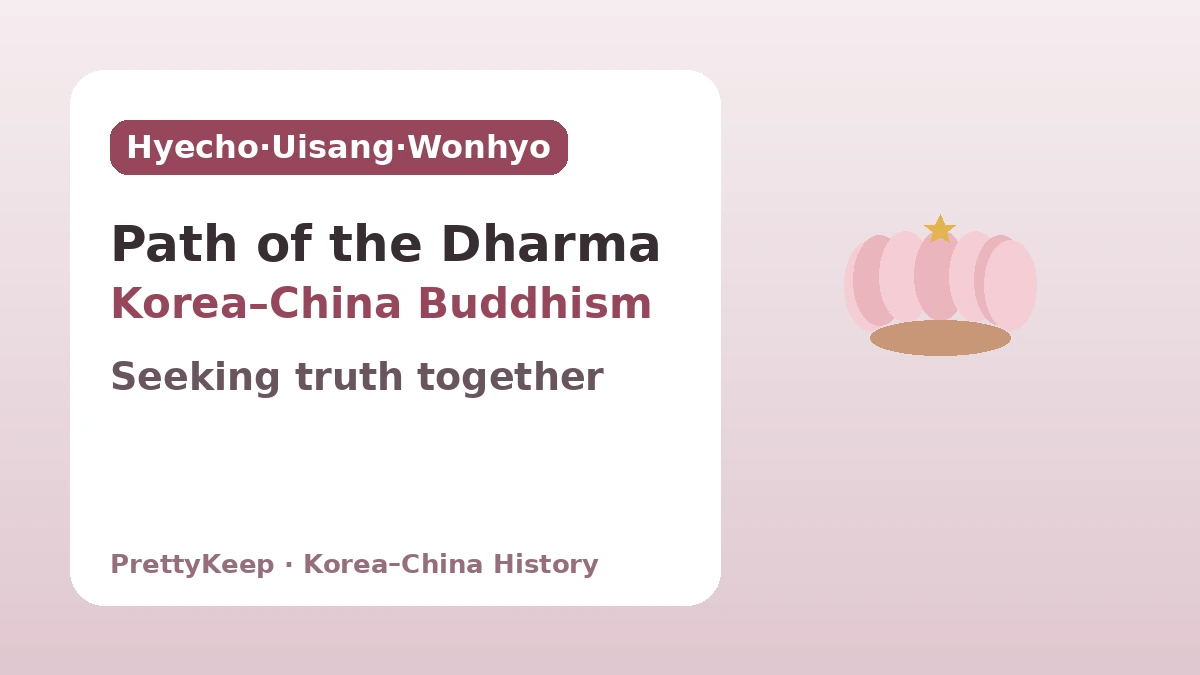
There were those who crossed the sea in search of truth. The monks of Unified Silla went to Tang China
to seek the Dharma, and even onward to distant Cheonchuk (India). Hyecho pilgrimaged through India and
the Western Regions and left behind the "Wang ocheonchukguk jeon" (Record of a Journey to the Five
Indian Kingdoms); Uisang studied Huayan learning in Tang and returned to lay the foundation of Korea's
Hwaeom school; and Wonhyo attained a great awakening on the road toward Tang. Their journeys are the
most radiant scenes of Korea–China Buddhist exchange.
This guide introduces, from a Chinese visitor's perspective, the path of seeking the Dharma that Silla
monks took through Tang and into the wider world, and the Korea–China Buddhist exchange continued along
the way. Chinese temples and eminent monks appear together in this story, showing that the two nations
were deeply linked through the spiritual world of Buddhism.
Korea preserves temples and museums where you can meet their footsteps and Buddhist culture. Touring
indoor exhibits together with quiet temples, you can calm the mind without strain even in recovery.
────────────────────────────────────
Understanding Korea–China Buddhist exchange
────────────────────────────────────
1) Why they went to Tang
Tang China was then the center of Buddhist learning. Silla monks studied in Tang to seek a deeper
Dharma, and some went as far as Cheonchuk.
2) What they carried on
Scriptures, learning, and thought went back and forth, and Silla monks developed what they learned
independently in Korea. Buddhism became a great bridge of the two nations' spiritual culture.
3) How we introduce it
① Respect the journey of seeking and exchange ② Present the Korea–China points of contact in balance
③ Introduce it as culture and history rather than as faith.
Key point: the path of Hyecho, Uisang, and Wonhyo is "an exchange of the spirit, widened together
toward truth." Buddhism was a bridge of the heart that deeply linked Korea and China.
────────────────────────────────────
Korea–China Buddhist exchange walk TOP10
────────────────────────────────────
No.1
Hyecho and the "Record of a Journey to the Five Indian Kingdoms"
Meaning A Silla monk's record of pilgrimage through India and the Western Regions
Point A journey of seeking the Dharma that went through Tang into the world
For Visitors interested in world and exchange history
No.2
Uisang and Huayan thought
Meaning Korea's Hwaeom school, founded after studying Huayan in Tang
Point A case of scholarly exchange blossoming into thought
For Those interested in Buddhist thought
No.3
The story of Wonhyo's awakening
Meaning A great awakening attained on the road toward Tang
Point An anecdote of a thinker representative of Korean Buddhism
For Those interested in philosophy and thought
No.4
Buseoksa Temple and the traces of Uisang
Meaning A Hwaeom temple said to have been founded by Uisang
Point Temple culture left by Korea–China exchange
For Those who love temple architecture
No.5
National Museum of Korea, Buddhist Sculpture Hall
Meaning The beauty of Three Kingdoms and Unified Silla Buddha statues
Point The link to Chinese Buddhist art, indoors
For Those interested in Buddhist art
No.6
Bulguksa Temple and Seokguram
Meaning The essence of Unified Silla Buddhist art
Point A fruit of the era's East Asian Buddhist culture
For Those who want to see representative sites
No.7
Scripture and sutra-copying (sagyeong) culture
Meaning The world of Buddhist sutras copied by hand
Point Traces of exchange where writing and faith are linked
For Those interested in calligraphy and scripture
No.8
Templestay — a day at a temple
Meaning Rest and meditation at a quiet temple
Point A low-intensity experience suited to recovery
For Those who want rest for the heart
No.9
The international exchange of Silla study-monks
Meaning A network of monks who traveled between Tang and Cheonchuk
Point The coming and going of knowledge and faith across borders
For Those interested in international-exchange history
No.10
An indoor Buddhist-culture walk
Meaning Indoor-centered viewing focused on museums and exhibits
Point A quiet route light even in recovery
For Those who prefer comfortable indoor viewing
────────────────────────────────────
Details — how to tour
────────────────────────────────────
[Example walking route]
After understanding the link between Silla Buddha statues and Chinese Buddhist art at the National
Museum of Korea's Buddhist Sculpture Hall, spend quiet time at a downtown temple or in a templestay
program. If you have time, you can visit representative temples such as Buseoksa and Bulguksa and
appreciate the Buddhist art left by Korea–China exchange. Starting with indoor exhibits keeps the
burden light.
[Why it is especially meaningful for Chinese visitors]
The Tang temples and eminent monks from whom Silla monks sought learning appear together in this story.
For a visitor from China, there is great resonance in discovering how one's own Buddhist culture passed
to Silla and developed anew.
[An attitude of respect]
Buddhist exchange is not a matter of superiority of faith but a journey of the spirit widened together
toward truth. We introduce it from the perspective of culture and history rather than religious
assertion. Please observe etiquette when visiting temples.
[Connecting with a medical-tourism schedule]
Indoor museum exhibits, downtown temples, and templestays are static and low-intensity, so they suit
recovery especially well. They are good for calming the mind and resting in a quiet environment.
Notes for medical tourists (most important)
- Above all, follow your clinic's recovery guidance (period, precautions) for every itinerary.
- After a procedure, center on indoor exhibits and downtown temples, and avoid UV and long walking.
- When joining a templestay, avoid strenuous programs and keep to rest-centered options.
- If you feel dizziness, pain, or other abnormal symptoms, stop at once and contact your clinic.
────────────────────────────────────
Frequently asked questions (FAQ)
────────────────────────────────────
Q1. How are Hyecho, Uisang, and Wonhyo connected to China?
A. All three are deeply connected to study in Tang. Hyecho went through Tang to Cheonchuk, Uisang
studied Huayan in Tang, and Wonhyo attained awakening on the road toward Tang.
Q2. Can I enjoy it even without a religion?
A. Yes. You can fully enjoy it from the perspective of culture, history, and art rather than faith.
Q3. Where can I see it comfortably?
A. You can grasp the core comfortably at indoor exhibits such as the National Museum of Korea's Buddhist
Sculpture Hall.
Q4. Is a templestay okay even in recovery?
A. If you choose a rest-centered program, the burden is light. Check your clinic's recovery guidance
first.
Q5. Is Chinese-language guidance available?
A. Major museum and temple programs often provide multilingual guidance. PrettyKeep helps.
Q6. What should I be mindful of when visiting temples?
A. Observe quiet and etiquette, and follow on-site guidance on photography, dress, and so on.
────────────────────────────────────
Medical-tourism tips
────────────────────────────────────
1. Follow your clinic's recovery guidance above all for every itinerary.
2. Center your route on museum indoor exhibits and downtown temples at low intensity.
3. Keep a templestay to a rest-centered program without strain.
4. After a procedure, avoid UV and long walking.
5. If your condition declines, stop at once and contact your clinic.
────────────────────────────────────
About PrettyKeep
────────────────────────────────────
PrettyKeep is a Korea travel and medical-tourism guide platform for foreign visitors.
- We curate indoor-centered, low-intensity walking and meditation courses on Korea–China Buddhist
exchange history (every itinerary reflects the clinic's recovery guidance above all)
- Route design that minimizes travel near the clinic, with interpretation support
- One-stop courses weaving museum, temple, and templestay experiences together with recovery schedules
- Symptom response and clinic connection
A day to meet the Korea–China exchange of the spirit, widened together toward truth — comfortably, with
PrettyKeep.
────────────────────────────────────